Saturday, November 8, 2014

AM-LEarning 2014!

I can't believe this is my 5th year teaching in the middle school, and I have never heard of the AMLE (American Middle Level Educators) conference until their arrival to Nashville this year. It was two and half days of quite an assortment of learning opportunities. The conference was was kicked off with a group of motivating keynote speakers such as Dave Burgess, Cedrick Gray, Nikki Woodson & Kim Campbell. Mission accomplished, I walked out of the ballroom totally pumped and honored to be an educator.

I'm recording all of the brilliant ideas I saw this weekend before I forget them, or I file them away never to be seen again.

Teach Like a Pirate - Dave Burgess
My first session was the Teach Like a Pirate session with Dave Burgess. I had already read his book a couple of years ago, and his performance strongly reinforced the idea of creating an experience for kids by making the lessons come alive. While his lesson on teaching the branches of government was in his book, seeing it in person completely makes sense now. I am totally stealing this idea!

LGBT - Norma Bailey
Due to the horrible service at the restaurant as I waited for my lunch, I almost missed this session. I am so glad I walked out without my lunch. Norma was amazing! She beautifully stated that gay students are no more special than other students, but they are no more less either. So, how can we break the silence? Her suggestions included:
  • Make LGBT issues explicit in the curriculum. 
    • Easy to infuse in social studies with current events. Civil Rights unit is a natural path, not everyone has civil rights. A great essential question: What starts a civil rights movement?
    • Language arts by using good literature such as:  Annie On My Mind, SP likes AD!, The Misfits (perfect for middle school), I am Jazz (picture book)
    • Identify when an author is gay or lesbian.
    • Science: genetics unit - Why are people gay?
    • Math: Bring in graphs about LGBT data/people.
  • http://glsen.org/nonamecallingweek
  • How to handle harassment:
    • Stop the harassment
    • Identify the harassment
    • Broaden the response
    • Ask for change in the future
Close Reading
I also attended a few close reading sessions. The tying in of text evidence, finding patterns, and the value of questioning was pretty much the focal point in all of the sessions. Some ideas I want to try out are:
  • Using metaphors to extend the thinking. "How is _____ like ________?" (example: How is water like electricity?) Then having the kids go back to the text to find text to support it. 
  • Using the 5W & 1H to pull key details found in the text, then having students share and anchor it back to the text by having them provide the page number where the information was found.
  • Image analysis by 1st asking students "What do you see?" then using a Sense-O-Gram chart
  • Ask "What did the words make you see?" instead of "What did you read?"
Motivate & Engage Students to Think Critically through Close Reading of Complex Text - Leah Ames
Love the idea of students experiencing the value of multiple interactions with the text to deepen understanding by using the short clips from www.theinvisiblegorilla.com and the Doritos "Missing Cat Super Bowl XLVI" commercial.


Doritos Commerical
1st view What did you notice?
2nd view How did it happen?
3rd view Why or why not?

Another suggestion was to use songs such as "Brave" by Sara Bareilles, which generated a deep discussion among our group.

Note & Notice by Kylene Beers & Bob Probst
This duo did not disappoint! I had read their wonderful book and am anxiously awaiting their non-fiction version to be published. They ran through teaching kids to notice the six signposts with their accompanying anchor questions. Tell kids to read with their PENCIL in their hand! These strategies are helpful because the kids know the questions, so they will also know the answers or at least be looking for them as they read. Using this method gives the students ownership to the text.

If You Can't Manage Them, You Can't Teach Them! - Kim Campbell
Kim Campbell is an energetic and motivating presenter!  I was so impressed I sat through two of her sessions. I plan to buy her book on Monday.

Here are some of her ideas I plan to use:
  • Partner Talking strategy 
    • Partner A (talker) & B (listener - smile/nod only)
    • Talk for 30 seconds (timers were a big deal, sense of urgency)
    • Teacher approaches B to tell her what A said
  • Brain Breaks (students can only listen to their age in minutes)
    • Pinky and hand movement
    • Get the Wiggles Out - 12345 (arm), 12345 (other arm), 12345 (each leg), 12345 (tush), 1234..., 123...., 12..., 1...
    • Egg, Chicken, Cow, Human - Rock, Paper, Scissors 
    • Rock, Paper, Scissors - sit when you lose, can get back up when their opponent loses to another person
  • Groupings
    • Index card 4 square to group up, 2 they pick and 2 where you give a criteria, helps with quick groupings
  • Signals
    • claps
    • eyes on me
    • hands on head
    • chanting "When I say middle, you say school"
  • Don't have more than 3-4 pet peeves at a time (try foam sheet for desk tappers)
  • Never use "sh" 
  • Use EXPECTATIONS not RULES - rules are meant to be broken
  • NEVER redirect the same kid about a behavior twice! Hold them accountable.
  • Post it Note Review Study Strategy (make extras for the early finishers)
    • Write a name of a person, place or thing on post it
    • Exchange Post It's (without seeing what the new post it says), put it on forehead
    • Ask classmate 3 questions to try to figure it out
    • Come back to seat when music starts 
  • Draw it! Describe it! Do it!
    • 1 or 2 = draw it (Pictionary)
    • 3 or 4 = describe it
    • 5 or 6 = do it, act it out
  • Keyword Prediction - pre-reading strategy. Post random keywords for students to predict with their AB partners, collaborate as they play around with the words, even make up questions then ask teacher question. Then bring it up a notch by showing an image - what do you notice, wonder?
  • 20 Word Summary in exactly 20 words summarize the main points after a 10 minute lecture.
  • Mystery Participate - put 3 student names in your pocket, if all three of the kids participate get to play a round of Rock Paper and Scissor tournament. Don't tell them who it was if you don't meet the expectation.
AMLE's offerrings allowed me to be put a bit of everything on my learning plate. It was truly satisfying, just what I needed to take my teaching to the next level.

Sunday, September 7, 2014

Understanding the World Through Geography

The National Council for Geographic Education (NCGE) holds an annual conference that is hosted in different cities every year. This summer it was held in Memphis which seemed like the perfect opportunity for me to connect and learn along with other educators from around the globe. There were so many interesting sessions offered that I, at times, felt torn wanting to be in three different places at one time!


A major part of the sessions included student learning opportunities that incorporated Geographic Information System (GIS). Advances in technology now allow our students to have access to current data which engages them in analysis, interpretation and critical thinking related to data maps.  ArcGIS Online, a cloud based program, is one of those resources.  ArcGis along with Google Maps also allows for time travel to explore past landscapes throughout history. The idea is for students to become geo-literate, looking for patterns in real-time like where people live and why.


National Geographic also presented its recently launched resources that offers educators map-based materials designed to build spatial thinking skills. Their mobile friendly technologies allow students to create and share their own map-based, multimedia geotours.


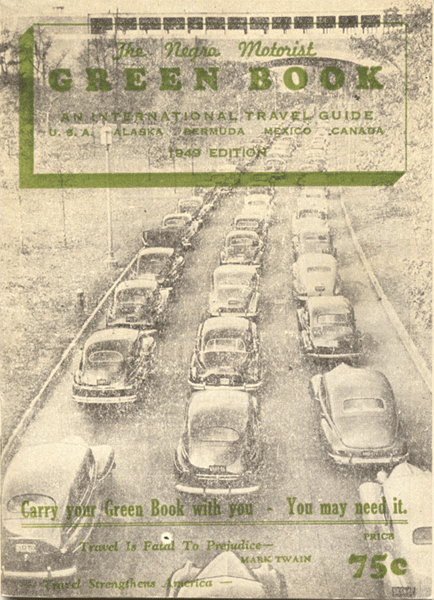
In addition to the GIS concept, sessions included activities using literature to make connections to reading, primary sources and maps. I felt like I was making curricular tweaks with each session I attended! For instance this year in our Civil Rights unit, I plan to incorporate the Green Book (1936-1964) which helped African American automobile travelers identify accommodations during the Jim Crow era. The session showcased teaching strategies using the Green Book, as a primary source, and the picture book Ruth and the Green Book in relation to geographic advancements in studying race relations, mobility and civil rights.


The last day of the conference a quote posted from President Obama caught my eye, "The study of geography is more than just memorizing places on a map, it's about understanding the complexity of our world." It truly sums up how the conference reinforced the importance of geography and that maps tell stories. The possibilities of using 21st century technology just makes the learning experience more authentic and engaging.


Tuesday, September 3, 2013

Revamped Tech Infused Geography Unit

So I spent a great deal of my summer redesigning my dreaded geography unit. While the skills and objectives remained the same, the new and improved unit has more application practices. Having a set of 20 iPads living in my classroom has extended the possibilities as far as my creativity can run with it. I continue to use the five themes of geography as the framework for teaching geographical thinking. However, I felt I went much deeper this time around. In partnerships, the students worked on self selected landscape images from anywhere in the world. I partnered up with our school librarian in order to build copyright awareness. In the library classroom, students explored www.searchcreativecommons.org as a source for images. Most students found the most success using Wikimedia through the Creative Commons website.  


Students were also provided with the following rubric:

5 Themes of Geography Rubric Mini-Project - QUIZ GRADE

Criteria
Description
Points
Title
Must have location & each partner’s name.
5
Pins
* Each theme is represented by a different colored pin.
* Must have at least one pin per geography theme.
* Placement of the pins on image are related to labeled theme - with the exception of location, place, region.
20
Text
* Explanation of how the theme applies to the image must be accurate and clear. Do NOT just copy your notes or type the name of the theme.
* Make sure to include how your theme is being applied to your image (ex. Movement: people, ideas, & good).
* Need to include absolute & relative location.
30
Image
* Each pin must have a photo, with the exception of place.
* Images for location and region themes must be maps.
* Photos/maps add meaning or support to your text.
30
Sources
Include a pin different from the theme pins to represent your sources used (Wikimedia, Flickr, etc.)
10
Shared
Project is linked to edmodo group & labeled with location & each partner’s name.
5

POINTS EARNED


Then off to the races we were, opening up Thinglink accounts, and crossing my fingers that the 5th graders would remember their passwords the next day. So much for crossing my fingers! Even having them use the same password/username as they had recently been assigned to sign into the school website proved not to be foolproof. Many of the students typed in their passwords/usernames incorrectly which led to the multiple requests to reset their accounts.


The project itself was wonderful! It will definitely be a repeat next year with a few tweaks. Thinglink was a terrific platform for the students to apply their knowledge of the five themes of geography. The Thinglink learning curve was minimal, very user friendly.  I then had them embed the link onto edmodo. A homework assignment was for the students to go into edmodo and provide meaningful comments to three of their peer's Thinglink projects. I then graded their projects right on edmodo. One bump I ran into was that embedding the link did not work for all students. The images would not completely load onto the site. Next year, I will have students simply link their project instead.


I was blown away by how must thought the students put into this project. We spend a total of three class periods working on this project, and it was totally worth it. Not only was I able to assess their geographical thinking, but I also evaluated how they worked collaboratively, their written expression and grammar skills along with how closely and accurately they followed a rubric. These were all great starting points for the new school year. Hoping our next geography U.S. states project using 30 Hands will be just as successful!

Here is one example of their work:


Wednesday, August 7, 2013

Summer Learning Reflection Game Changers

What a summer it has been, full of active learning - mostly self directed too. There was some traditional professional learning involved such as attending ISTE in San Antonio along with 10 other colleagues. This summer I experienced my first unconference, a PrincipalMeet and a TeachMeet. I also filled my learning time reading books such as "Essential Questions" by Grant Wiggins and "Design for How People Learn" by Julie Dirksen. However, most of my learning and collaborating was done virtually. I participated in book & weekly chats, listened to podcasts, watched webinars, collaborated with my PLN, and along the way made new Twitter connections. I was able to pick and chose areas that interested me the most, the ultimate DIY PD.

I spent a good amount of time learning and using new apps of which I plan to use with my students this year such as:
30 Hands
Aurasma


Thinglink
This summer has also been pivotal in shifting the way I design lessons. I actually spent a great deal of time revamping my most dreaded unit, geography. Paul Solarz (@PaulSolarz) played a big part in helping me rethink how and why I was teaching geography. It simply started with a tweet, and his comments on my Google document were extremely valuable. Just the spark I needed to take off with my planning. He is a wealth of knowledge and generously shares.

I also jumped in and started designing a class website using Google Sites. It is still a work in process, but I am feeling good about providing my students with a landing places to find resources, links, and information about my course/units. They too will be using Sites for their digital portfolios, another new experience for me. My students will continue to use Edmodo and Kidblog as collaboration platforms. I also started blogging myself. Which I find to be a powerful, reflection tool. It is so helpful to dump all of my thoughts and learning into a blog. I've also enjoyed reading other people's blogs. Now, I can share with my students my personal blogging experience, just as I expect them to be bloggers.

I also have more of an understanding of how the 20% Project concept works, and I connected with people on Twitter that I can rely on for support. I am so curious to see how the concept will work with my students.

My classroom will also be different this year. I've gotten rid of my teacher desk, my room instantly became larger. Instead of desk, I will have a rolling podium that will house my teacher laptop and iPad. Twenty iPads will be living in my room, no more anxiety as to whether I will have access to technology. This will be a game changer for sure!
                              

With all of my learning experiences in hand, I am so excited for the first day of school. When people ask me if am ready for school to begin, I immediately answer "YES!" I usually get a surprised "Really?" response. I can't wait to take my new learning and ideas out for a test drive. Hoping for smooth sailing, but I realize not everything will work as planned. I will embrace and learn from the failures and relish from each successful learning experiences. It's is going to be a great year!


Friday, July 26, 2013

TeachMeet KY Learning Takeaways


Finally the day came yesterday for me, the opportunity to experience my first unconference type gathering. Will King (@wkingbg) and Allen Martin (@AlsTechTime), both whom I met at ISTE, invited me to crash their Bowling Green school district Teach Meet. As I followed their keynote speaker, Adam Taylor (@2footgiraffe), from Nashville, TN to Bowling Green, KY, I wondered if the event would seem awkward given that I was not a Bowling Green public school teacher. However when I walked into the Bowling Green High School, I was pleasantly surprised not to experience a moment of awkwardness. Actually quite the opposite happened, the teachers were so kind and welcoming. Our shared passion for learning and teaching completely blurred the fact that I was not a teacher in their district.

The Newscasts for Any Classroom was a wonderful session. Janet Martin walked us through the steps of setting up and implementing the project. Working in groups, students would learn how to plan and write/storyboard a segment of a newscast. The newscast would include a lead story, other stories, weather, commercials, traffic, etc. The integrated tech piece involved using iMovie to film and edit their production. I am going to attempt to use this idea with my explorer unit. So instead of individually presenting one by one about their explorers, groups of explorers will create one newscast. I can only imagine the creative student productions that will transpire!  Janet's SlideRocket presentation can be found at www.tinyurl.com/TMnewscast. As part of her resources, Janet also shared this great clip on storyboarding to show students.


As I walked out of the newscast session, Kim Calhoun (@CalhounDOwork), a 9th grade history teacher, approached me about some cool ideas she had in her classroom.  In her classroom, she began pulling amazing student projects out of a box. At the moment, the cardboard boxes seemed more like treasure boxes to me. Kim had her students create War World II poster foldables. I immediately started to think of the different ways I could use her ideas with my own students. She generously gave me a sample to take with me. I now plan on using foldables with my American Revolution unit. I keep hearing and reading that "learning should be a hot mess." Well, nothing screams "hot mess" more than a classroom full of students with paper, scissors and glue!

Infographics is a tool I have not yet used, but I totally see the platform as an opportunity for students to effectively show their understanding. So, I was pleased to learn the basics from Will King's session on how to help kids sort and organize data. I loved the simplicity and visually appealing graphics of this image Will shared with us.


I plan to use this tool early on in the school year as a culminating geography unit project. I am leaning toward using http://www.easel.ly/ which is still on my summer learning "to do" list.

Adam Taylor's session on engaging students with technology was full of practical and easy to use tools. I was particularly glad to get a Socrative overview since I plan on using this assessment tool with my students this year.

As I left the session of how to embed Web 2.0 tools into a web page, Ms. McCoy, took me to a back room to show me their green screen. I was amazed, I wish we had this set up at our school. I was completely impressed by how cleverly an iPad box, an 8 x 10 frame glass, and velcro became a stand/holder for an iPad to film productions.


Overall, my first Teach Meet was a day full of learning, a total success. I can't wait for my next unconference. Now I understand the excitement that runs through Twitter as people tweet about the unconference craze.


Sunday, July 21, 2013

Learner's High, Who Knew!

After spending a year on Twitter reading posts and blogs, I am finally ready to join the blogger world. It is not that I don't appreciate the power of reflection and sharing, I just felt like blogging would be yet another "to do" item on my ever growing list. I also thought I really did not have much to say that has not already been or would be said through my remarkable PLN's blogs. However, I've come to realize that blogging needs to be more about my own reflections as an evolving educator. It's a personal journey, but if I can contribute or inspire others to try something new, it's an added bonus!

This is such an exciting time in education. In the past year, there has not been a day I have not learned something new or have been willing to jump outside of my comfort zone. As I take more risks, it seems like I crave more challenges. I use to be an avid runner and would push myself until I experienced a 'runner's high.' Honestly, I felt like I could run forever. Well since having my third child and years of wear and tear on my body, I can no longer run. I never thought I would be able to reach the incredible 'runner's high' feeling until I jumped on the tech ed learning wave. There is something about being totally consumed with learning and reaching that 'eureka moment' that sends me into a superhero mode and fuels my motivation for the next challenge.  Who knew that there was such a thing as a 'learner's high!'  Yes, I've become a learner junkie. My hope is to lead my students in a couple of weeks on discovering their own 'learner's high' experiences.